Hi, I'm André. I dig through customer reviews for the one line that sells ✦ then I make the ad around it.
For the last year and a half I've been making performance ads for DTC brands, first as Lead Designer at GrowthPod and now as Creative Strategist at Dog Friendly Co. Before that, ten years in design and advertising. I own the whole pipeline: research, strategy, concept, art direction and production.
See the ads ↓55+ DTC brands · one pipeline
Some ads I've made. Each one began as a research doc.
Every decision on the canvas is a strategy decision.
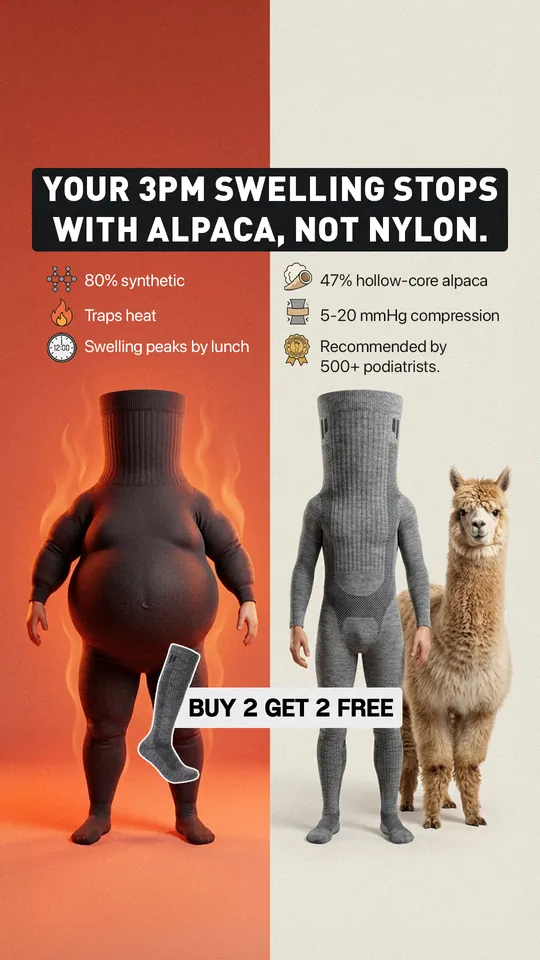
One of my compression-sock ads, taken apart. Nothing here is decoration: each element answers something the research surfaced.
 1
2
3
4
5
1
2
3
4
5
- 01
Hook: name the moment
Your 3PM swelling
instead of "tired legs." A specific moment the customer already knows from their own day reads as recognition, not as a pitch. - 02
Enemy: give the problem a face
Not nylon.
The villain is something they already own, so the switch feels obvious. The heat, the bloat and the red side make it visible before a word is read. - 03
Framework: Us vs Them
A hard split down the middle: hot vs. calm, synthetic vs. alpaca. The comparison reads in half a second, even with the sound off and the thumb moving.
- 04
Proof: where the eye lands second
47% hollow-core alpaca
·5–20 mmHg
·500+ podiatrists
. Proof sits right under the hook, mirrored against the enemy's claims, so the argument closes itself. - 05
Offer: inside the safe zone
Buy 2 Get 2 Free
sits on the product, between both worlds, where the thumb hesitates. The image explains, the offer converts.
From a one-star review to a running ad.
One pipeline, one owner. I don't hand research to someone else to interpret or hand a brief to someone else to guess at. The same head carries the insight all the way to the file.
Dig
I start where customers talk: reviews, comments, Reddit threads, competitor ads. I mine them for the exact words people use, the objections they repeat, and the moments that hurt enough to buy something.
- Brand & product context
- Claim / proof matrix
- Voice of Customer bank
- Objection bank
- Competitor map
- Ad library read
Decide
Research only matters once it turns into a bet. I map personas and jobs-to-be-done, name the tensions, and write every angle as a hypothesis we can test. Then I forecast which ones deserve budget first.
- Personas & JTBD
- Insights & tensions
- Hypothesis table
- Creative forecast
Make
Concepts, headlines and briefs, and then I direct the image myself: framework first, hierarchy second, craft third. AI-assisted production lets one strategist ship at the volume a performance account needs.
- Concept bank
- Headlines & copy
- Briefs
- Art direction
- AI image production
Learn
Every ad is a question. I read what the account answers, log the learning, and feed it into the next round. The work that converts teaches the work that comes after it.
- Performance read
- Learnings log
- Next-round iterations
Six structures I direct from.
Honestly? I just love ads. A good one is a tiny machine: one insight, one image, half a second to land. I like taking them apart, and I like building the next one even more.
The creative is the targeting.
The algorithm uses the ad itself to find the audience. The hook, the hierarchy and the first frame are the signal. My job is to make it unmistakable.
Understand the angle before you design it.
If I can't say the idea out loud in one sentence, no amount of craft is going to rescue it.
Taste is a result, not a starting point.
When the angle and the hierarchy are right, the aesthetic falls into place. Pretty without a point is just decoration.
Speed is a craft decision.
Velocity comes from removing every guess from the process, not from cutting corners.
Recognition
- Grand Prix, 2 Gold, 2 Bronze, 5 ShortlistsLa Guapa School Festival · 2023
- ShortlistCannes Young Lions Paraguay · 2024
Education
- Digital Marketing SpecialistMiami Ad School
- Art DirectionBrother Creative School
- CreativityLa Guapa School of Creativity
- BA Marketing & AdvertisingUniversidad Americana · in progress
Toolkit
Think
Make
Ship
Got a product people should stop scrolling for?
I'm always up for talking ads: strategy, art direction, or the whole pipeline. Based in Asunción, Paraguay. Working remote with US, Canadian and Australian teams.